After Mostar, we parted with the ship crew, and boarded on a bus to ride back to Zagreb. It was a long ride. While we passed some nice landscape with thick forest, it was a misty day for any nice photo shots. When we made a stop for lunch, I was able to take two pictures of the Krka River:
Opatija is a resort town, with a wonderful view of the beautiful Adriatic Sea. The good thing is that the city built a path along the coast which allows pedestrians walk along the water front without any interruption by hotels, or shops. I took a two hours walk in the morning before the bus head toward our final destination - Zagreb. My heart was refreshed.
I am entering "retirement" next May(2011), and want to start tracking my life as I see it.
Sunday, January 19, 2014
Moster - Bosnia & Herzegovina
Early in the morning, we arrived Neum. Our ship had to anchor in the middle of the water. We took a smaller boat to the shore and started our bus journey to Moster.
The sun rise:
A little island belongs to Croatia, but close to the Herzegovina region, which still presented conflict between the two nations:
House along the Neretva River. It is a beautiful river. But our guide told us that the river was stained by blood during the Bosnia war, as so many people died without proper burial.
One can see a fortress perhaps left from the Ottoman era on the hill.
We knew that we were close to Mostar when we see more of the Muslim structures.
On a street of Mostar, there was a sign pointed toward a Bazar, and all the activities forbidden in the Bazar.

The inside of a mosque by the Bazar
The pebble covered street leading to the Bridge
The famous Bridge, a UNESCO Heritage Site, which divides the town into Muslim and Croat sections. the Bridge was designed by the Ottoman architect Mimar Hayruddin the the 16th century. The original structure was destroyed by a bomb during the Bosnia conflict in 1993. UNESCO helped fund its rebuilding as a symbol of unity.
The above is a view from the top of the Bridge. I was able to go down by the river and had a picture of the Bridge from below.
On the Muslim side, a stone marked "Don't forget '93"
A building damaged during the Bosnia War, and was left as is so that people won't forget. Below is a Muslim cemetery. One can not help feeling sad with a heavy heart after visiting Mostar.
The sun rise:
A little island belongs to Croatia, but close to the Herzegovina region, which still presented conflict between the two nations:
House along the Neretva River. It is a beautiful river. But our guide told us that the river was stained by blood during the Bosnia war, as so many people died without proper burial.
One can see a fortress perhaps left from the Ottoman era on the hill.
We knew that we were close to Mostar when we see more of the Muslim structures.
On a street of Mostar, there was a sign pointed toward a Bazar, and all the activities forbidden in the Bazar.
The inside of a mosque by the Bazar
The pebble covered street leading to the Bridge
The famous Bridge, a UNESCO Heritage Site, which divides the town into Muslim and Croat sections. the Bridge was designed by the Ottoman architect Mimar Hayruddin the the 16th century. The original structure was destroyed by a bomb during the Bosnia conflict in 1993. UNESCO helped fund its rebuilding as a symbol of unity.
The above is a view from the top of the Bridge. I was able to go down by the river and had a picture of the Bridge from below.
On the Muslim side, a stone marked "Don't forget '93"
A building damaged during the Bosnia War, and was left as is so that people won't forget. Below is a Muslim cemetery. One can not help feeling sad with a heavy heart after visiting Mostar.
Friday, January 17, 2014
Korcula, Croatia
Korcula ia another island that had been ruled by Venice for centuries. It was also rumored that Marco Polo was born here on the island. St Marks Cathedral on the main square was unique due to its detailed Romanesque portal by Bonino of Milano depicting Adam and Eve on either side of St Mark perched at the top.
The above house on the left was said to be the birth place of Marco Polo.
City Wall:

The above house on the left was said to be the birth place of Marco Polo.
City Wall:
Hvar Island, Croatia
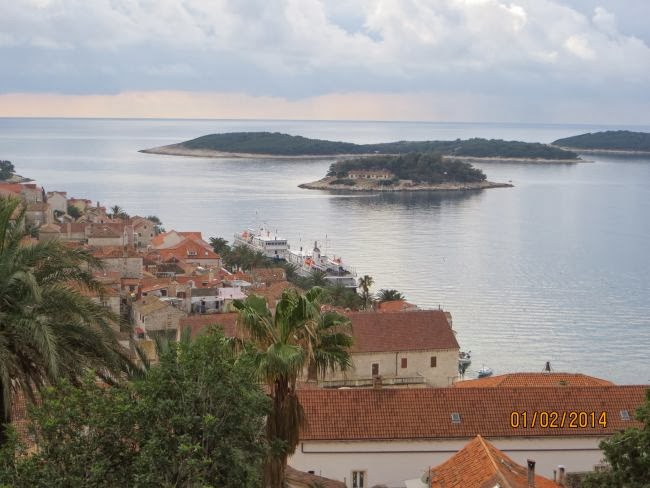
Hvar Island turned out to be one of my favorite stop on this trip. It was occupied since at least 3500 BC, and has been ruled variously by Greeks, Romans, Ottomans, Austrians, and French. But one can still see its character as a place of fresh fish, herbs, vineyards, and its Venetian flavor. I like it because I was able to climb up to the hill top and see the Venetian fortress stood high overlooking the Croatian isles.
The fishermen just returned and were cleaning up their catch:
A walk around the Old Town, one can see much Venetian flavor:

An old well with the book held by the Venetian Lion closed - meaning the time was at war:
The Venetian fortress on top of the hill:
I could see our ship parked below by the water front:
We then drove to visit a local winery, which was near a church built as a fortress, in the event of sudden arrival of invaders.
The fishermen just returned and were cleaning up their catch:
A walk around the Old Town, one can see much Venetian flavor:
An old well with the book held by the Venetian Lion closed - meaning the time was at war:
The Venetian fortress on top of the hill:
I could see our ship parked below by the water front:
We then drove to visit a local winery, which was near a church built as a fortress, in the event of sudden arrival of invaders.
Dobrovnik, Happy New Year
Subscribe to:
Posts (Atom)